Free tool · Metric & imperial
TDEE Calculator
Estimate your Total Daily Energy Expenditure — the calories you burn per day — and get starting targets for cutting, maintaining, or lean bulking. Same published formulas the Fitzenia app uses.
Calculate your TDEE
The math
How this calculator works.
Your BMR is estimated with the Mifflin-St Jeor equation from weight, height, age, and sex. If you enter a body fat percentage, the calculator switches to Katch-McArdle, which works from lean body mass instead — usually the better fit for lean, muscular people.
TDEE is then BMR multiplied by an activity factor. Most calculators make you pick that factor from one dropdown, which squeezes training and everyday movement into a single bucket — so a desk worker who lifts four times a week lands on the same number as someone who lifts four times a week and walks 15,000 steps. Those are not the same day.
So this calculator asks the two questions separately, exactly like the Fitzenia app's onboarding: your weekly sessions and your daily step band together decide the level. Be honest with both — when in doubt, pick one level lower.
| Activity level | Multiplier |
|---|---|
| Sedentary — under 5k steps, no training | ×1.2 |
| Lightly active — modest steps or a few sessions | ×1.375 |
| Moderately active — 10–20k steps, or 5–10k plus regular training | ×1.55 |
| Very active — 10–20k steps plus near-daily training, or 20k+ steps | ×1.725 |
| Extra active — 20k+ steps plus near-daily training | ×1.9 |
Beyond the formula
A formula is a snapshot. Your body is a trend.
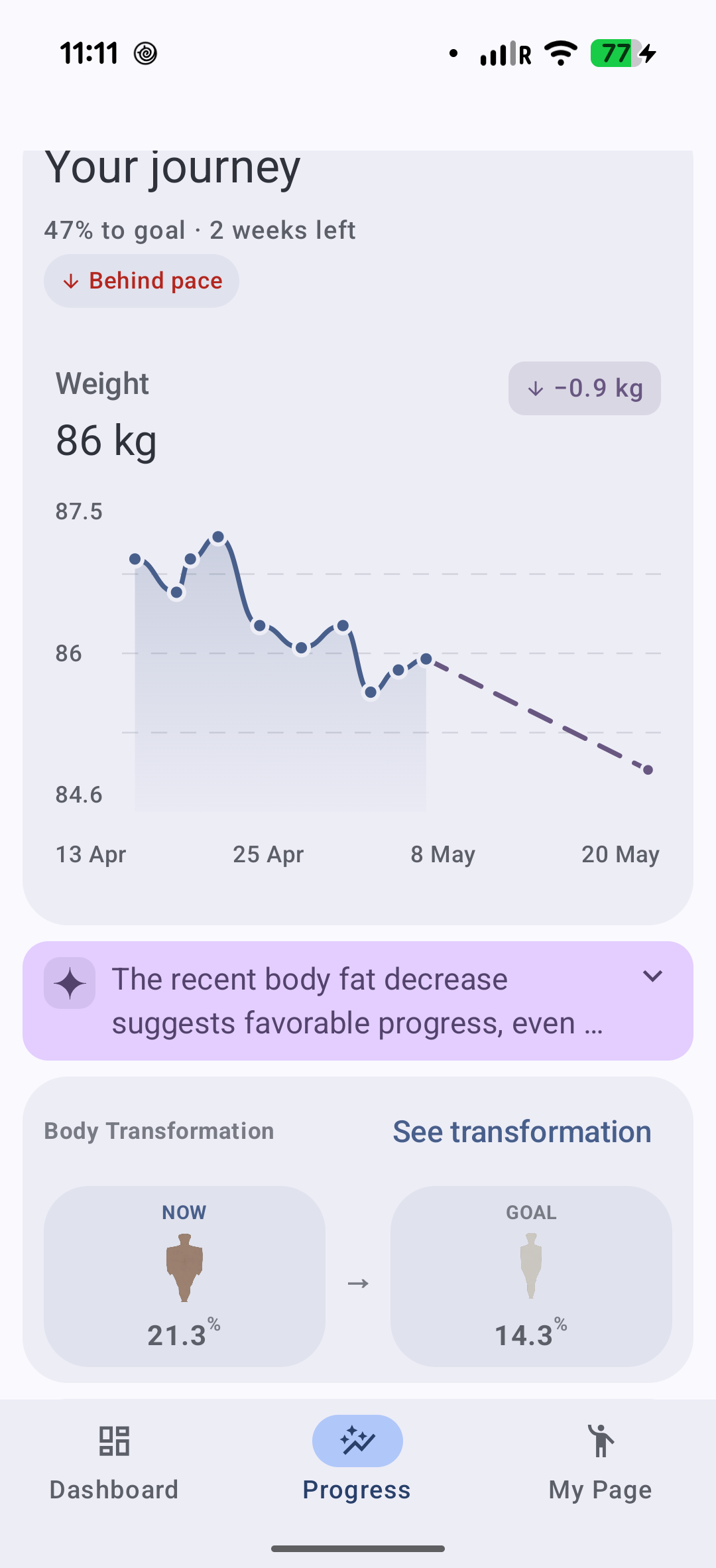
Every online calculator gives you a static estimate from population averages. Fitzenia starts there, then re-estimates your real energy needs from your own data — the food you log and the way your weight actually trends. Cut, bulk, or maintain: your calorie target follows what your body is doing.
Good to know
TDEE, explained.
What is TDEE?
TDEE stands for Total Daily Energy Expenditure — the total number of calories your body burns in a day. It combines your basal metabolic rate (the energy needed to keep you alive at rest), the food you digest, everyday movement, and exercise. Eating around your TDEE keeps your weight roughly stable, which is why it is also called your maintenance calories.
How is TDEE calculated?
This calculator first estimates your basal metabolic rate (BMR) with the Mifflin-St Jeor equation, which uses weight, height, age, and sex. If you enter a body fat percentage, it switches to the Katch-McArdle formula, which estimates BMR from lean body mass instead. That BMR is then multiplied by an activity factor between 1.2 (sedentary) and 1.9 (extra active). Instead of making you pick that factor from a single dropdown, this calculator derives it from two separate answers — your weekly training sessions and your daily step band — so everyday walking is not lumped in with exercise. These are the same published formulas and the same derivation the Fitzenia app uses for its starting estimate.
Do steps count toward your TDEE?
Yes, and they matter more than most people expect. Much of your walking falls under NEAT — non-exercise activity thermogenesis, the energy you burn outside deliberate training — and it adds up. Every 1,000 steps costs roughly 30–50 kcal depending on your body weight and pace, so someone averaging 15,000 steps a day can burn several hundred more calories than a desk-bound person with the identical training schedule. That is why this calculator asks for your daily step band separately from your weekly sessions: two people who train four times a week can still have very different maintenance calories. Enter your total step count for a typical day — the whole number your phone or watch reports, including any steps from training.
What is the difference between BMR and TDEE?
BMR (basal metabolic rate) is the energy your body needs at complete rest — breathing, circulation, and basic cell function. TDEE is your BMR plus everything else you do: walking, training, fidgeting, and digesting food. TDEE is the number that matters for setting calorie targets, because you do not spend your day at complete rest.
How accurate are TDEE calculators?
Formula-based calculators are estimates built on population averages, so your true energy expenditure can differ noticeably. Activity levels are easy to misjudge, and daily movement varies a lot from person to person. Treat the result as a starting point: follow your weight trend for two to four weeks and adjust your intake based on what actually happens.
What is adaptive TDEE?
Adaptive TDEE flips the approach: instead of predicting your expenditure from a formula once, it back-calculates it from real data — what you log eating and how your weight actually trends over time. The Fitzenia app uses this approach, re-estimating your energy needs from your own food log and weight entries so your calorie target reflects your real life instead of a population average.
How many calories should I eat to lose weight?
A common starting point is a moderate deficit of roughly 300–500 kcal below your TDEE, which for many people works out to about 0.25–0.5 kg (0.5–1 lb) per week. Larger deficits look faster on paper but are harder to sustain and make holding on to muscle harder. This is general information, not medical advice — consider consulting a qualified professional before making significant changes to your diet.
Should I recalculate my TDEE as my weight changes?
Yes. Formula-based TDEE depends on your body weight, so the estimate drifts as you lose or gain — recalculating every few weeks keeps it useful. Alternatively, an adaptive tracker like Fitzenia re-estimates your energy needs from what you actually eat and how your weight trends, so the target keeps up as your body changes.
Keep the number honest
Track it in Fitzenia.
Log food with barcode scan or AI photo, follow your weight trend, and let your calorie target adapt to your real TDEE.